 marinepoint


Types of boat fenders and how to size them
2026-07-21 · Marine Point
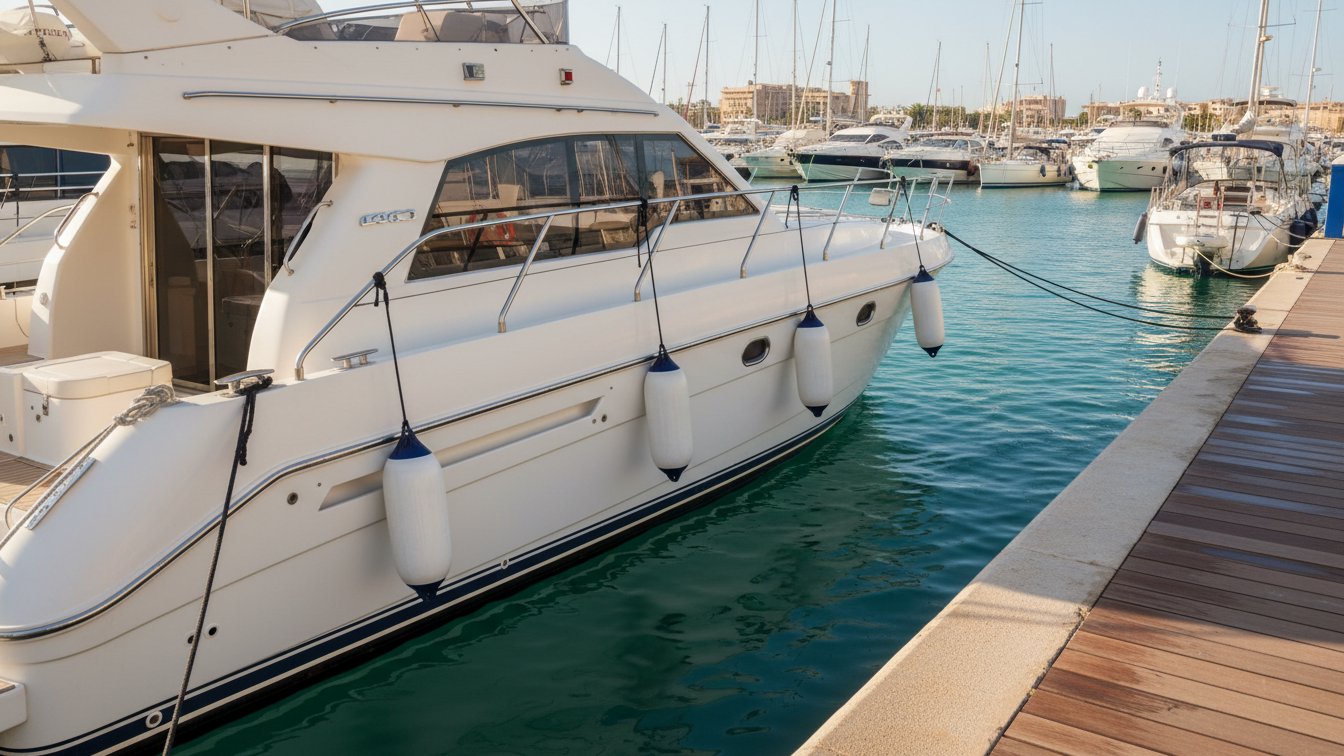
In August, with the Balearic harbours at full occupancy and more berthing manoeuvres every day, fenders stop being a secondary accessory: they are the immediate protection between our hull and the pontoon, another boat or the quay. Choosing them well is not about buying the biggest ones, but about combining the right shape, a diameter or volume suited to the boat and correct placement. We recommend what you need to moor with more peace of mind, not what costs most.
Which type of fender suits your berth
Cylindrical fenders are the most versatile and the most common. They work especially well in pontoon berths, offering a good contact surface as the boat moves with swell, wakes or wind shifts. They are a practical choice as the main fender on many leisure boats.
Round or spherical fenders provide a lot of volume and are useful when we need to hold the hull well clear of a high quay, a corner or a boat with less regular lines. They don't always replace cylindrical ones: often they do a better job in a specific role, for instance during a manoeuvre or at a particular berth.
There are also flat fenders, bow fenders, corner fenders and other formats aimed at specific areas. They can be very useful in berths with piles, pontoons with particular geometries, or to protect points of repeated chafe. Before choosing, look at where the hull actually bears in your usual berth, not just how you moor in summer.
In our anchoring, fenders, boat hooks and ropes category you can compare the formats you need to prepare your berth properly.
Sizing by length and beam
The boat's length is the first reference for choosing fender size, but it shouldn't be the only one. A beamy, heavy boat with high freeboard, or one kept in an exposed berth, may need more generous protection than another of the same length.
Check the manufacturer's application table for the chosen model and make sure the recommended size matches the intended use. Not all fenders work the same way or are designed for the same conditions. It is also better to have several well-sized units properly spread out than to trust all the protection to one very large fender.
The fenders' height must be adjusted to the contact point, normally near the widest part of the hull. In harbours with changing water levels, passing wakes or neighbouring boats of different sizes, check their position more often. A correct fender hung too high or too low protects very little.
Inflation: firm, without excess pressure
A fender should be firm enough to hold its shape, but not so hard that it loses its cushioning ability. Over-inflation reduces its effectiveness in an impact and puts unnecessary strain on the material and valves; too little pressure lets it deform too much and leaves the hull more exposed.
The safe reference is always the manufacturer's figure for each model. We recommend checking inflation before leaving harbour and again if the fender has spent many hours in the sun. In summer, Mallorca's high temperatures and the heat that builds up on deck can alter the internal pressure. Never improvise values or use uncontrolled compressed air.
Placement and upkeep in high season
For effective protection, hang the fenders before approaching the berth and secure them with lines in good condition, preferably to strong points on the boat. They should be quick to adjust, without knots that are hard to release under tension.
After each day out, rinse them with fresh water if they have picked up salt, sand or residue from the dock, and check valves, lines and chafe areas. Posidonia must not be removed or handled in the water: if some has caught during a manoeuvre, act carefully and respect the local rules. If you have doubts about size, layout or mooring points, you can ask us before equipping the boat.